I've indexed the NodeBox GitHub repo on several platforms just out of curiosity, but also, to help the community continue the discussion around NodeBox and AI (what is useful/what is not)...
- DeepWiki
I gave it a prompt asking exactly how to setup and connect nodes to create Guilloche designs with custom/adjustable parameters.
This was its first response:
Found a highly relevant example — a Spirograph node setup already exists in the codebase. Let me examine it directly, along with the corevector node library for relevant node definitions.
What I could confirm
NodeBox's vector geometry nodes live in the corevector library 1 , and the transform-and-duplicate logic your Yin-Yang example uses (Ellipse → Copy → Colorize → Combine) is exactly the same mechanism the codebase itself uses to build a Spirograph pattern — which is structurally the same technique as a Guilloché generator (repeated rotated/translated/scaled copies of a base curve superimposed to create the moiré-like interference pattern).
This is confirmed by a performance test that explicitly drives a copy1.rotate port on a bundled example to animate "a full spirograph": 2
That example file lives at examples/01 Basics/01 Shape/11 Spirograph/11 Spirograph.ndbx in the repo, but I was unable to retrieve its actual node graph contents through the index (see note at the end).
I was also able to confirm the exact port structure of the corevector.copy node — the same node used in your Yin-Yang description — from the format-upgrade code and its regression test, which manipulate a copy node's scale port (a Point) alongside translate/rotate/order/copies: 3 4
This matches your description of Copy node's Order, Translate, Rotate, Scale inputs one-to-one — confirming Copy is the right, and only, primitive you need for repetition/rotation, rather than building trigonometric formulas node-by-node.
Separately, handle classes reveal other relevant corevector shape/transform nodes exist beyond what's in your example: line, star, polygon, and reflect all have dedicated UI handles, meaning they exist as first-class nodes: 5
The reusable-group mechanism you asked about (custom "Networks") is the groupIntoNetwork action, which take selected nodes and turns them into a sub-network, and publish/unpublish, which expose a child node's port as an input on the network itself so the group behaves like a parameterized custom node: 6 7
The rendering semantics of a network confirm that a group renders whichever child is marked as its "rendered child," and published ports feed values from outside the group into specific child ports: 8
Recommended structure (conceptually)
A Guilloché pattern is mathematically the superposition of two (or more) rotating/translating frequencies applied to a base curve (the same principle as a Spirograph/hypotrochoid or an engine-turning lathe). In NodeBox terms that maps to nesting two Copy nodes, each representing one rotational frequency, rather than computing trig formulas directly:
- Base shape node (e.g.
LineorEllipse) — the "pen stroke" unit. Copynode #1 ("inner wheel"): smallRotateangle, manyCopies, small radialTranslate— produces the first epicyclic ring.- Wrap step 2 (base shape + Copy #1) into a custom Network, publishing
Rotate,Copies,Translate, andScaleas the network's own inputs — this becomes your reusable "Guilloché ring" building block, avoids re-deriving the same node chain per frequency, and matches howpublish/groupIntoNetworkare meant to be used. - Instantiate that Network twice (or more) with different published parameter values (different rotation speed/radius per instance) to superimpose frequencies, feeding the result of instance 1 into the
shapeinput of instance 2's innerCopy. Colorizenode(s) for stroke/fill styling of each layer.Combinenode to merge multiple layers/instances into one final output, exactly as in your Yin-Yang example.
What I could not verify
I was not able to pull the actual .ndbx XML contents of libraries/corevector/corevector.ndbx or the bundled 11 Spirograph.ndbx example — the search tool returned only match counts, not file bodies, likely due to index size limits on binary/XML asset files. That means I cannot give you exact default parameter values, port names for line/star/polygon/reflect, or the precise wiring used in the built-in Spirograph example (which would be the most authoritative concrete Guilloché template). I'd recommend starting a Devin session with filesystem access to open libraries/corevector/corevector.ndbx and examples/01 Basics/01 Shape/11 Spirograph/11 Spirograph.ndbx directly — that will give exact port names/defaults to replicate or extend, and confirm whether a dedicated "spiral" math node exists that could simplify the radial term instead of nesting Copy nodes."
I tried the same prompt again in a new session to clarify a more specific use case for the Guilloche designs.
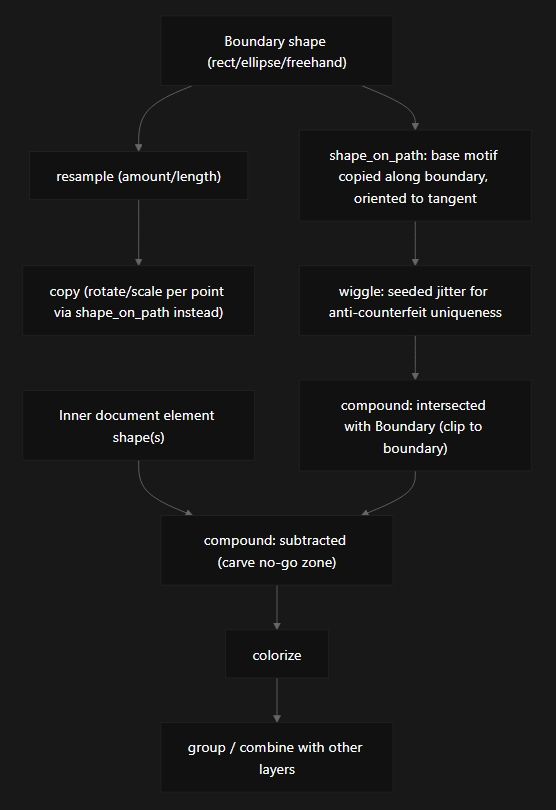
This response was much more direct and it even generated a conceptual diagram of a basic node layout!
See the attached 'guilloche_deepwiki' image...
You can read the first prompt/response conversation here:
https://deepwiki.com/search/i-would-like-to-know-what-node_7dbb47c3-79dc-4e32-98ac-7a5efcd830b6?mode=deep
And the second where I used the same prompt with calrifications and got the response explaining how to do it and the diagram as well, here:
https://deepwiki.com/search/i-would-like-to-know-what-node_11e77fcc-16ae-4da7-90b5-1ab37bfbd11a
- OpenDeepWiki
This one automatically generated a SKILL file that can be used by an agent to be an expert in NodeBox source code development - and potentially, for those who have 'computer use' type agents, USE THE SOFTWARE directly!
(This is the attached 'nodebox-nodebox-master-en-skill' ZIP file.)
- RepoWise
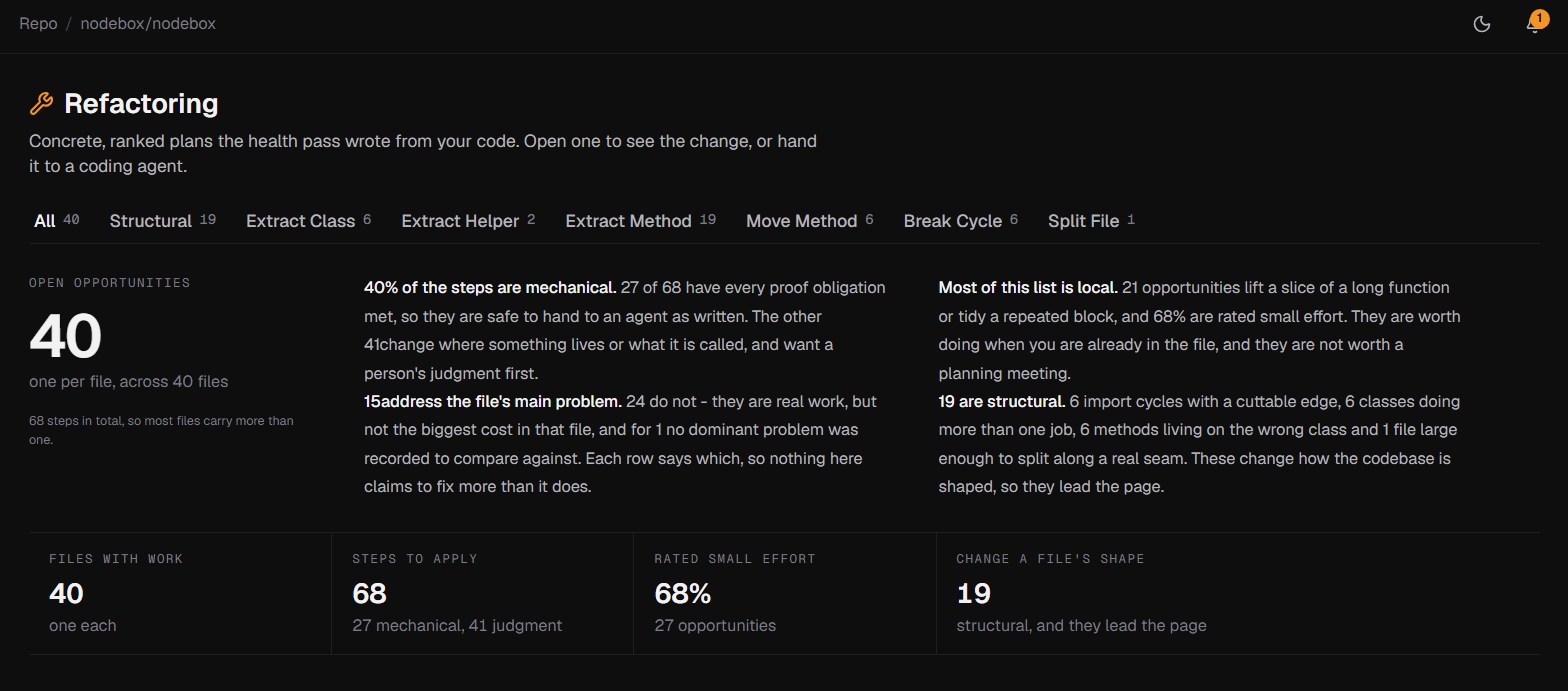
Provides a comprehensive analysis of exactly what parts of the source code itself will benefit, objectively, from refactoring. It then goes further by showing exactly which of those tasks are purely technical refactors that will not break any code and do not require any judgement or decision from a live developer to complete the fix - which it shows how to automate - and provides concise breakdowns of the remaining tasks that do need human judgement calls or those that are highest priority, or even least time consuming but also not as urgent.
And that is just the refactoring analysis... there are many more codebase insights and utilities.
I've attached a screenshot of the top of the refactor tab:
'repowise_refactor_tasks'
I tried to keep this short.
I highly suggest checking out the DeepWiki NodeBox page - this platform is 100% completely free to chat as much as needed and find out anything about how to use NodeBox or build new ideas out, as well as, development questions.
Straightforward with less features than the other platforms which geared towards developers and have the premium/paid features.
DEEPWIKI:
https://deepwiki.com/nodebox/nodebox
First conversation (where it explained how to go about using the Spirograph NodeBox example project approach to generate Guilloche designs...):
[https://deepwiki.com/search/i-would-like-to-know-what-node_7dbb47c3-79dc-4e32-98ac-7a5efcd830b6?mode=deep]
Second conversation (using same prompt with an extra paragraph at the end to clarify what I actually expected a bit more and ended up getting that along with a pretty nice diagram...):
[https://deepwiki.com/search/i-would-like-to-know-what-node_11e77fcc-16ae-4da7-90b5-1ab37bfbd11a]
OPENDEEPWIKI:
https://opendeep.wiki/nodebox/nodebox