Hi Lobstor,
Sorry for the delay in responding. Sometimes my pesky day job gets in the way.
You have stumbled onto a NodeBox quirk. What you want to do is straightforward and should be extremely easy - but it's not.
If you could concatenate all your words into a single string (or one string per paragraph) this would be effortless. When you feed that string into a textpath node all you have to do is set the width value (to anything other than the default of 0) and NodeBox will do the word breaks for you.
You can easily turn one string into a list of words (just use the make_string node and use a space as the separator), but strangely there is no way to do the reverse. There is a concatenate node, but it can only concatenate up to seven specific strings at a time. There is no "concatenate this list" node.
It would be fairly easy to write a custom node to do that in Python. So that's one workaround.
A stranger workaround is a to create a subnetwork that does a kind of cell division: combines each string into a pair of strings separated by a space. Each time you apply this "meiosis" the size of the list would be cut in half. String enough of these together (n where 2^n > than number of words in original list) and you would then have a single string which you could feed into the textpath node for an instant paragraph.
The catch with this approach is that you have to wire together the meiosis nodes by hand with enough nodes to match a specific number of words. Oddly, you can't just do this n times in NodeBox because NodeBox is stateless and has no ability to do recursion.
A more complicated method is to work with the words after each one has already been turned into a separate text path. You can find the width of each shape, compute a running total of these word shape widths, calculate a crude estimate of the break points, slice up the word shapes into subsets, and stack each set together to form lines. I say "crude" because you have to do all the lines at once; the second line cannot adjust based on exactly where the first line broke (that would, again, require recursion). The result is a somewhat ragged paragraph, but it may be good enough for your purposes.
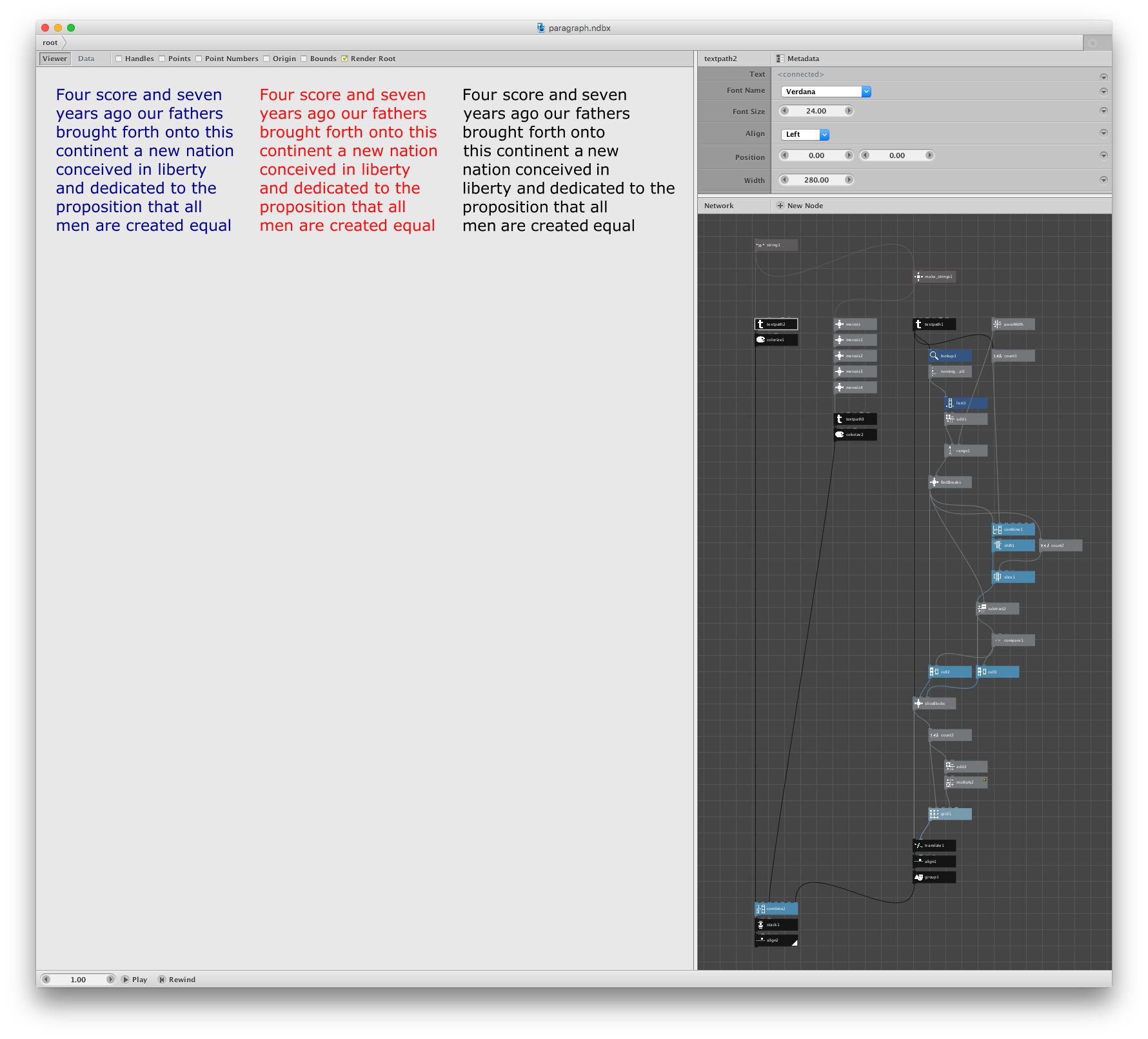
I have attached an example network that shows all three methods. I first create a string of the first sentence of the Gettysburg address. If you feed that directly into a text path node and set the width to, say, 280 you will get a nice paragraph in a single bound. I show the result in blue.
To demonstrate the other two methods I break that sentence into a list of individual words; this is your situation. First I feed that list into a set of five meiosis subnetworks to turn them back into a single line of text. The result of that is shown in red.
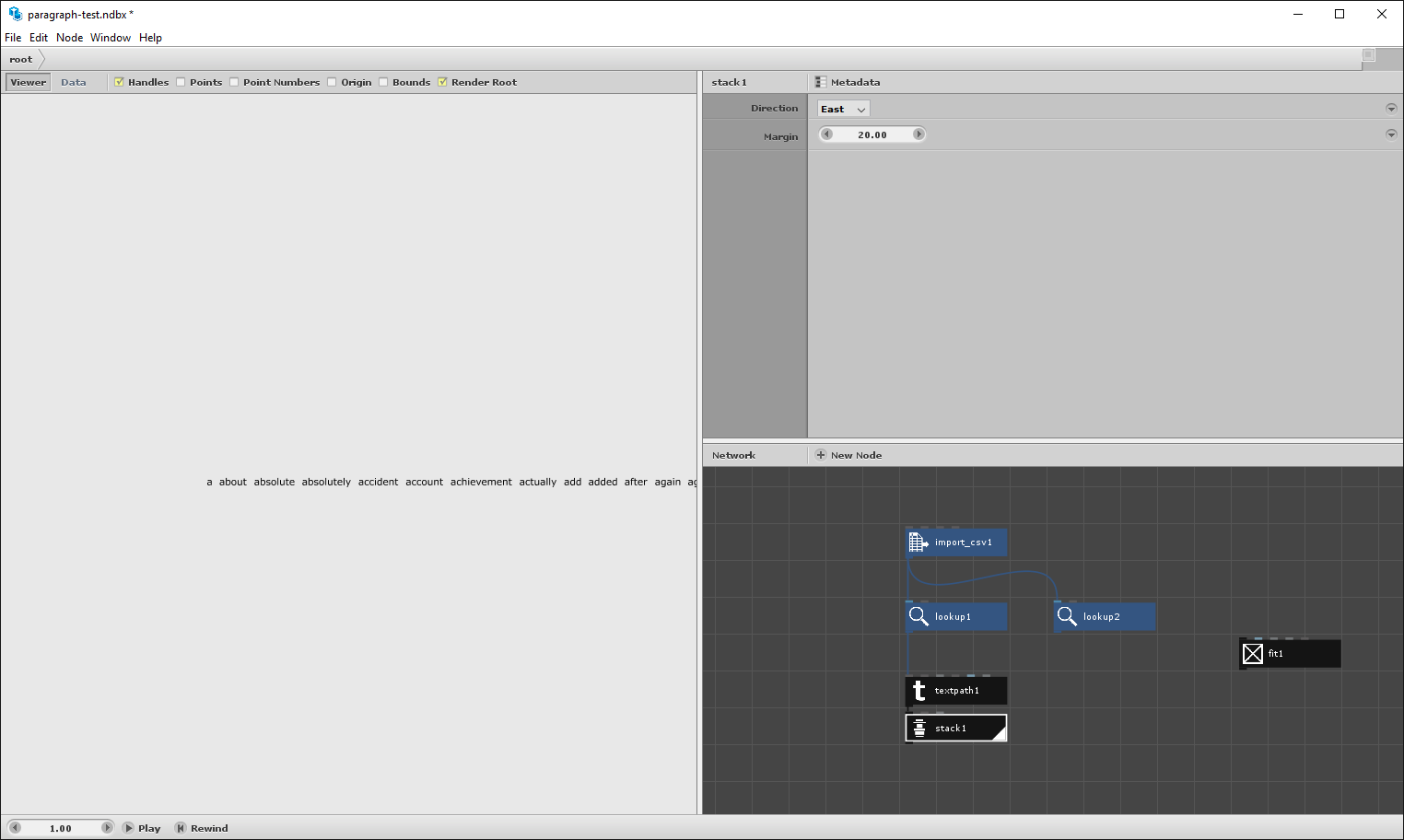
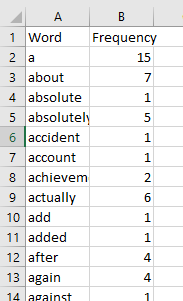
The third approach, using shape widths as described above, will work for any arbitrarily long list of words. You can just feed in a word lookup from any CSV file. The result, a tad ragged but not too bad, is shown in black. You can fiddle with the "paraWidth" number to adjust the paragraph width.
Sorry for such a long note. As I said, this should be simple, but it's not. But don't let this discourage you from using NodeBox. This is a corner case; for most projects NodeBox works just fine.
Good luck and please keep playing and asking questions.
John