I've been having so much fun with my Sanzo_colors node that I decided we could all benefit from another historical color palette node. For this I turned to a project by longtime Nodebox user and data visualizer extraordinaire, Nick Rougeux,
Werner's Nomenclature of Colours was a book of color samples amended and polished by P. Syme in 1821, It, in turn, was based on an 1814 book of colors found in nature, collected and named, by Abraham Gottlob Werner. Werner and Syme's book was especially popular with naturalists and was used by Charles Darwin. A few years ago, Nick produced his spectacular interactive online version and included the source data I used for this node.
Werner_color has four parameters:
- Color Suite. The collection is divided into ten suites: Whites, Greys, Blacks, Blues, Purples, Greens, Yellows, Oranges, Reds, and Browns. You can choose any one of these or stick with the default, All, which returns all the colors.
- Number (0=All). Entering a 0 here returns all the colors in the selected suite; any other value returns a specific color:
- If suite is All and Sort by luma is unchecked, Werner's original color number will be used to select a color.
- If a particular suite is selected and Sort by luma is unchecked, the colors from that suite will be returned in sequential order; 1 will return the first color in the suite, 2, the second, etc.
- If Sort by luma is checked, regardless of suite, the number will return a sequential color from the sorted list arranged from dark to light based on luma value.
- If you enter a number greater than the number of colors available in the given suite, the final color value will be returned.
- Sort by luma. If checked, colors will be returned based on their luma values, from dark to light. If unchecked, colors will be returned based on Werner's classic ordering.
- Output. Choose one of three possible outputs:
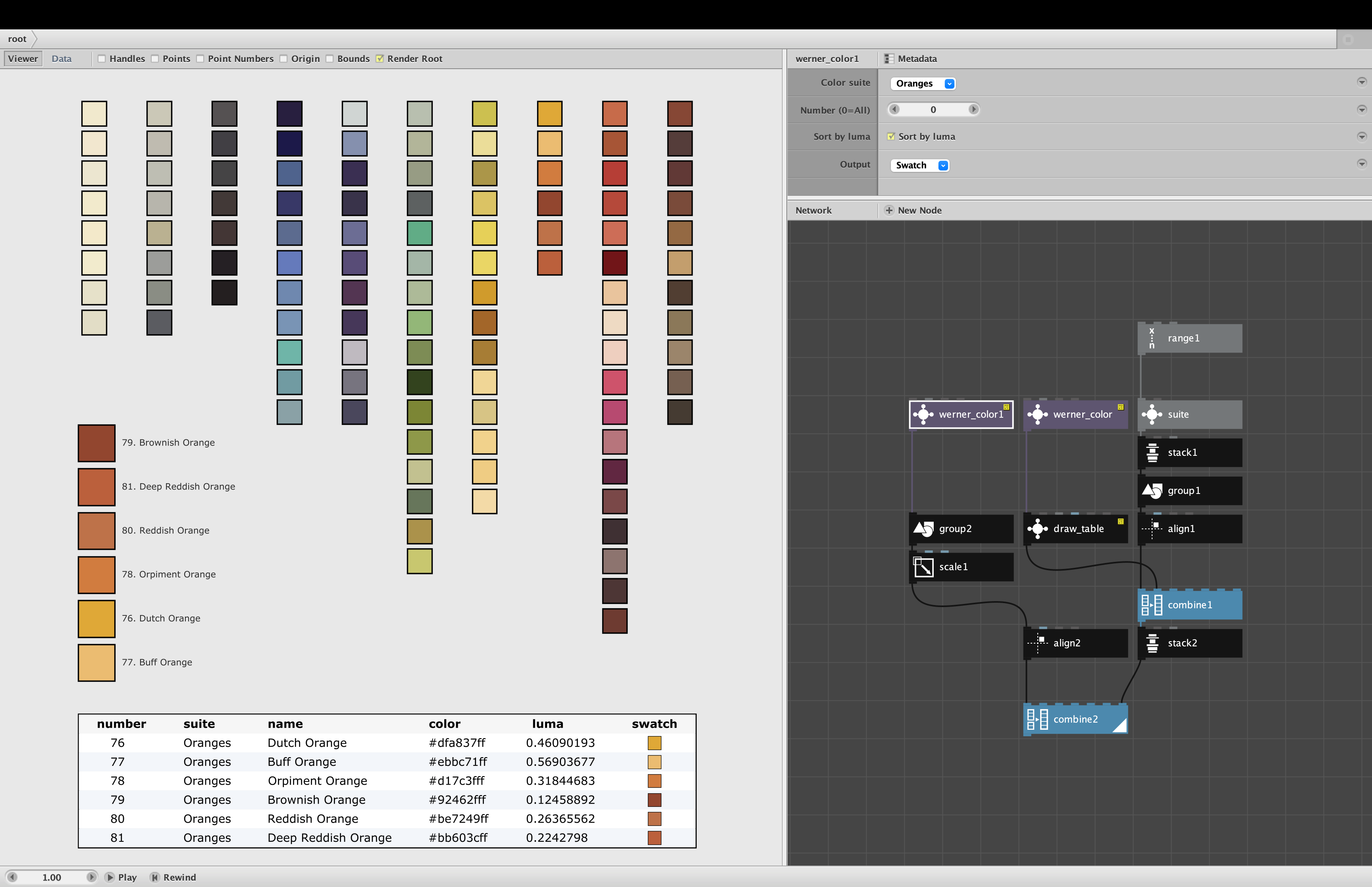
- Swatch returns a swatch or list of swatches consisting of a color sample labeled with the color's number and name.
- Color returns one or more colors. This is what you will probably want if feeding the output to other nodes.
- Table returns a data table with one row per selected color. The columns are number, suite, name, color, luma, and swatch.
The attached demo (see screenshot) shows all three types of output: the colors themselves (arranged in columns by suite), a list of swatches for the orange colors, sorted by luma, and a data table of those same orange colors in their original order.
This node provides yet another way to explore colors and apply them to your projects. You can feed them directly into my palette or gradient nodes to produce beautiful spectrums of color. The colors are drawn from animals, plants, and minerals found in nature and can create charming effects.
Enjoy! And please share your creations here on the forum if you can.