The new NodeBox forum is live! Everything from support.nodebox.net moved here: sign in with the same email to pick up your old posts. Something not working? Write to forum-support@nodebox.net.

NodeBox 3From the old forum

urgent help needed for a knitting project

5 replies Last reply

  1. hello hello, good people of nodebox!

    i'm a design student and i love this community.
    jpeg in the attach file will be enough for explaining my situation.
    my current skill set is not enough to generate the whole range.
    i could not be able to do was to use V shapes without breaking
    in the middle and joining together without making weird endpoints.
    VVVVV ← all i wanted to was this perfect knitting shapes.
    after generating that range, my aim to design a variable type face out of this.
    any help would be so lovely an sorry for barging in like this,
    i am in a kind of a really time sensitive situation.

    please and thank you.
    another huge thanks goes to Mr. Cartan.
    without Cartan Library i could not even come this far.

    Copy link
  2. Hey Diov,

    I am not 100% sure what exactly you want to have as a final output.
    But I suppose you just want to visualize those V shapes according to an underlying font shape. And those V shape should always stay intact and never be partly cut away, right?

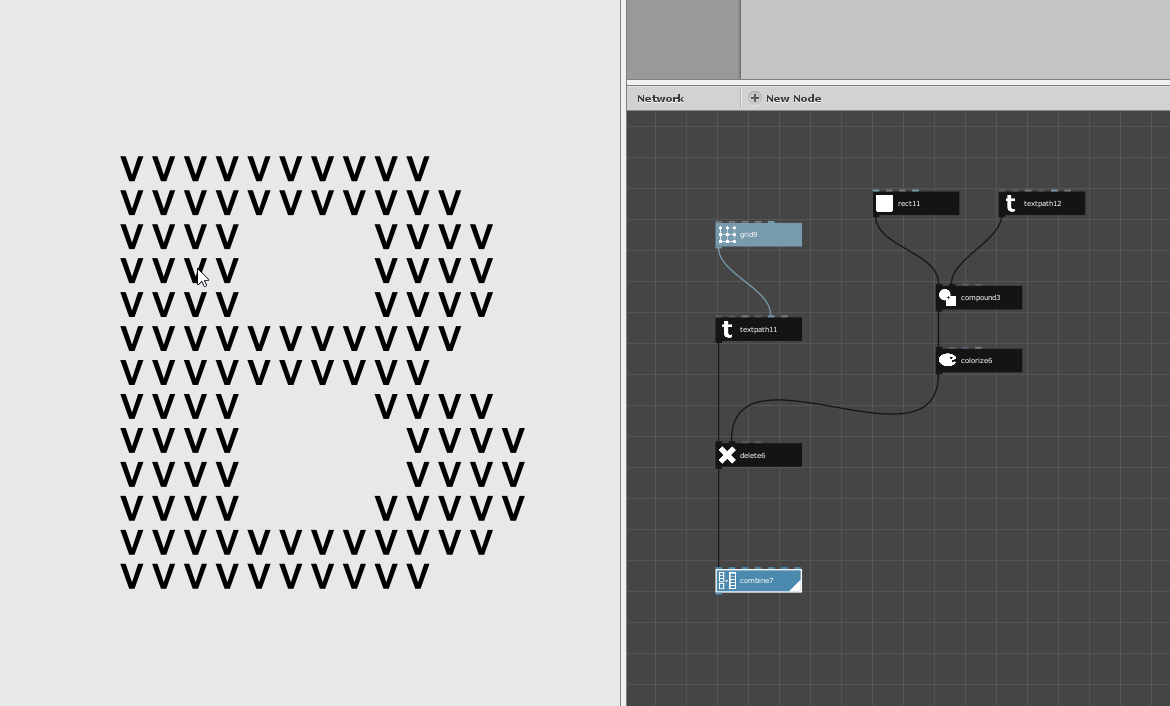
    One easy way to go about this is to

    1. create a grid first
    2. remove points in that grid that are outside the font shape
    3. clone your V shape to each of the remaining points

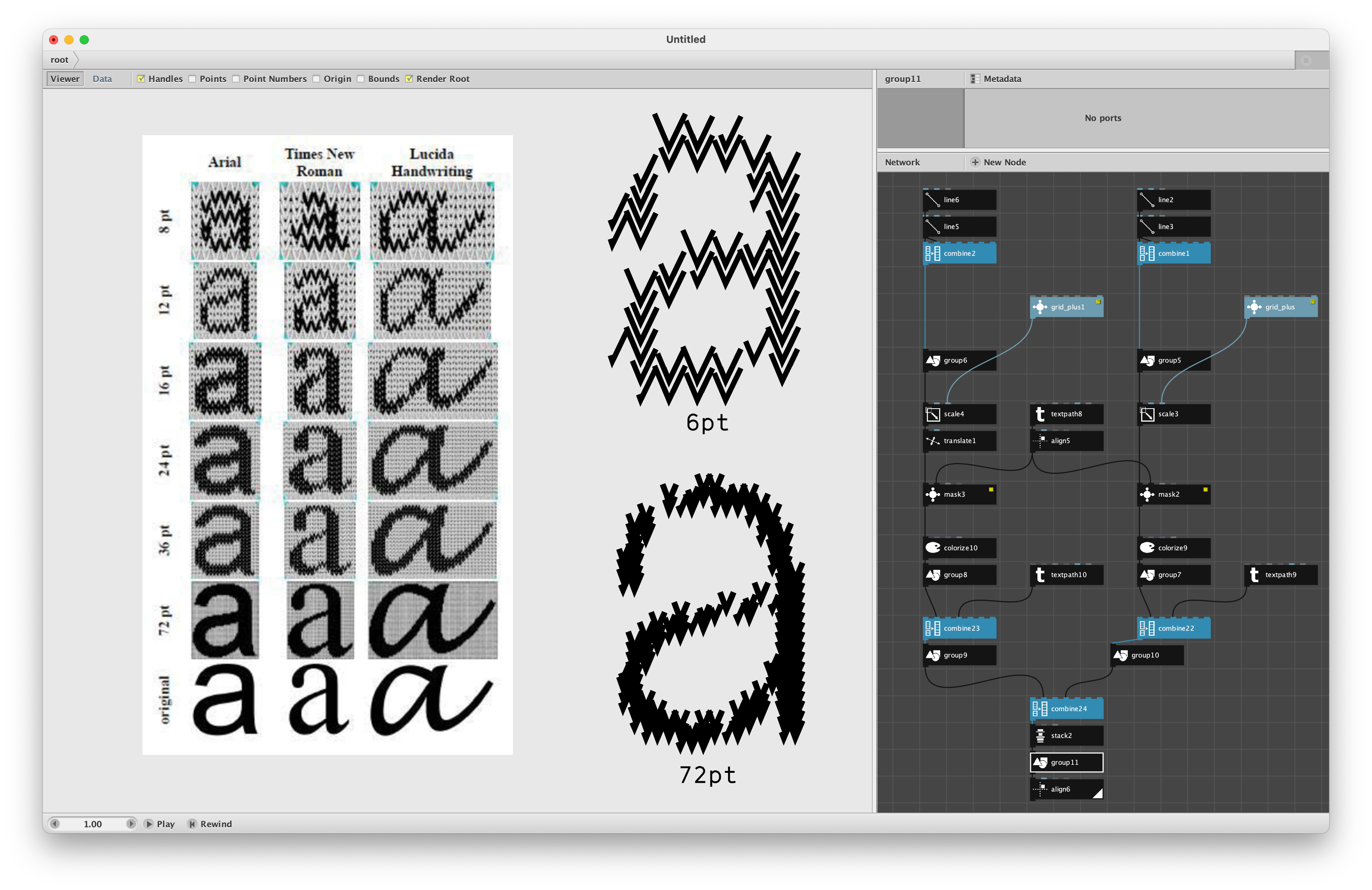
    I created an example network. (attached)

    Note: this is just for visualizing. The black V shapes double on top of white V shapes (background). And they are not connected at all. If you wanted to have one continuous connected zig zag line per row (stitching pattern), then there would need to be a bit more processing.

    Let me know if this helps.

    Copy link
  3. tolifox, lastvector; THANK YOU!

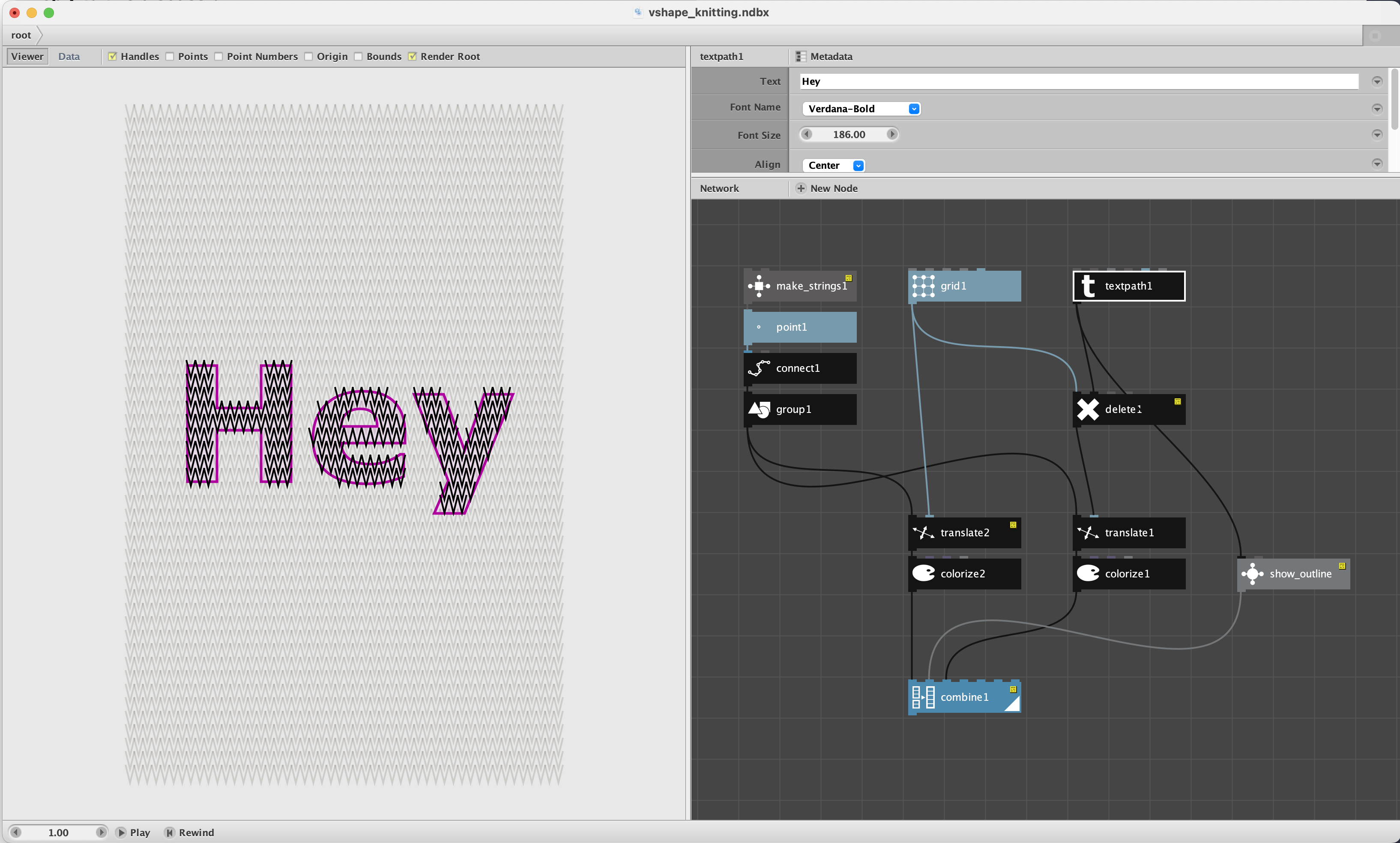
    i dialed most of the stuff manually but it's nearly done-ish.
    thank you both for reminding me; all i need was simply the delete node.

    now, onward to give this a good spin and a real generative structure which it exactly what i need to learn.

    one last thanks to you all out there, peeping, yes, you :)

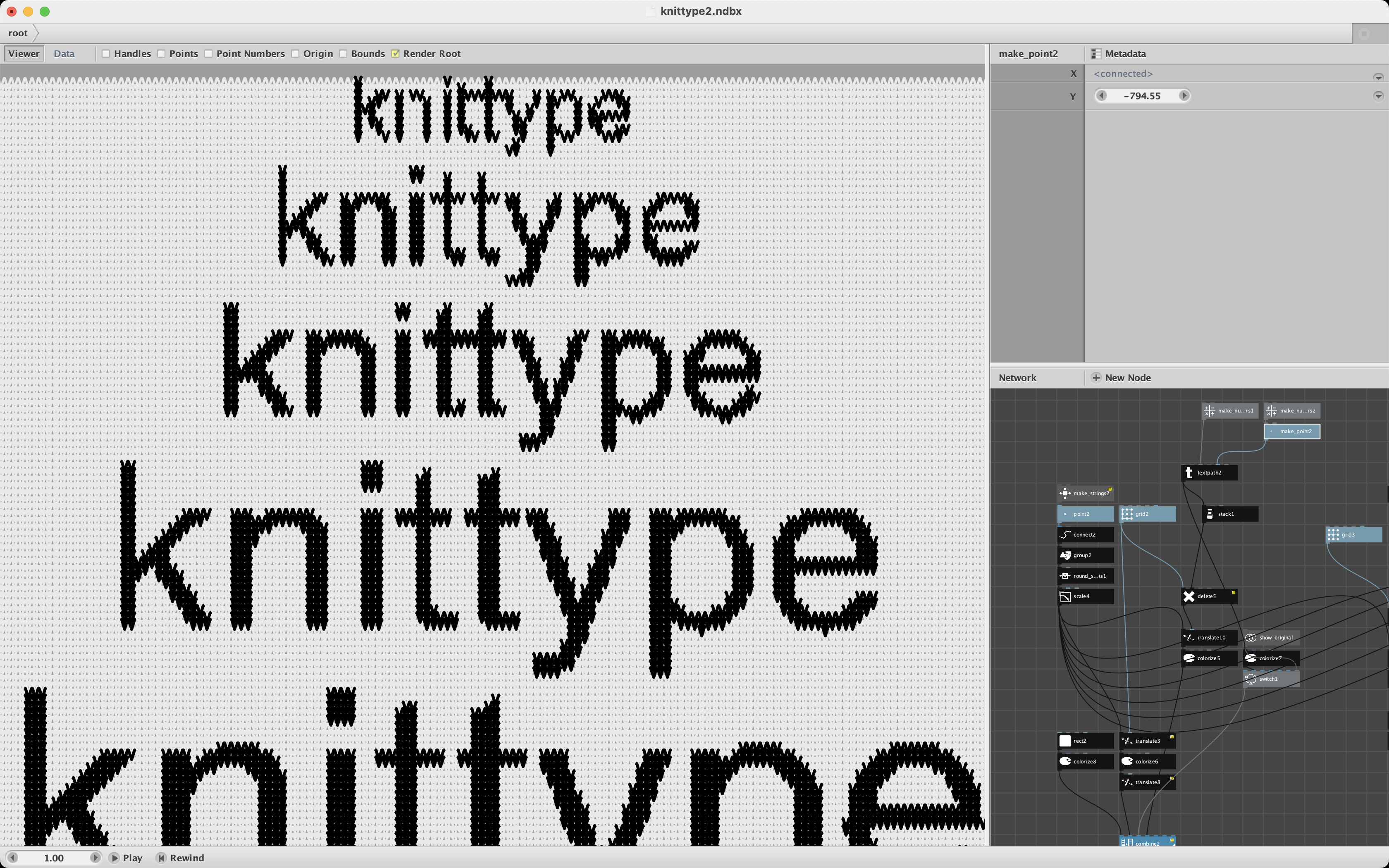
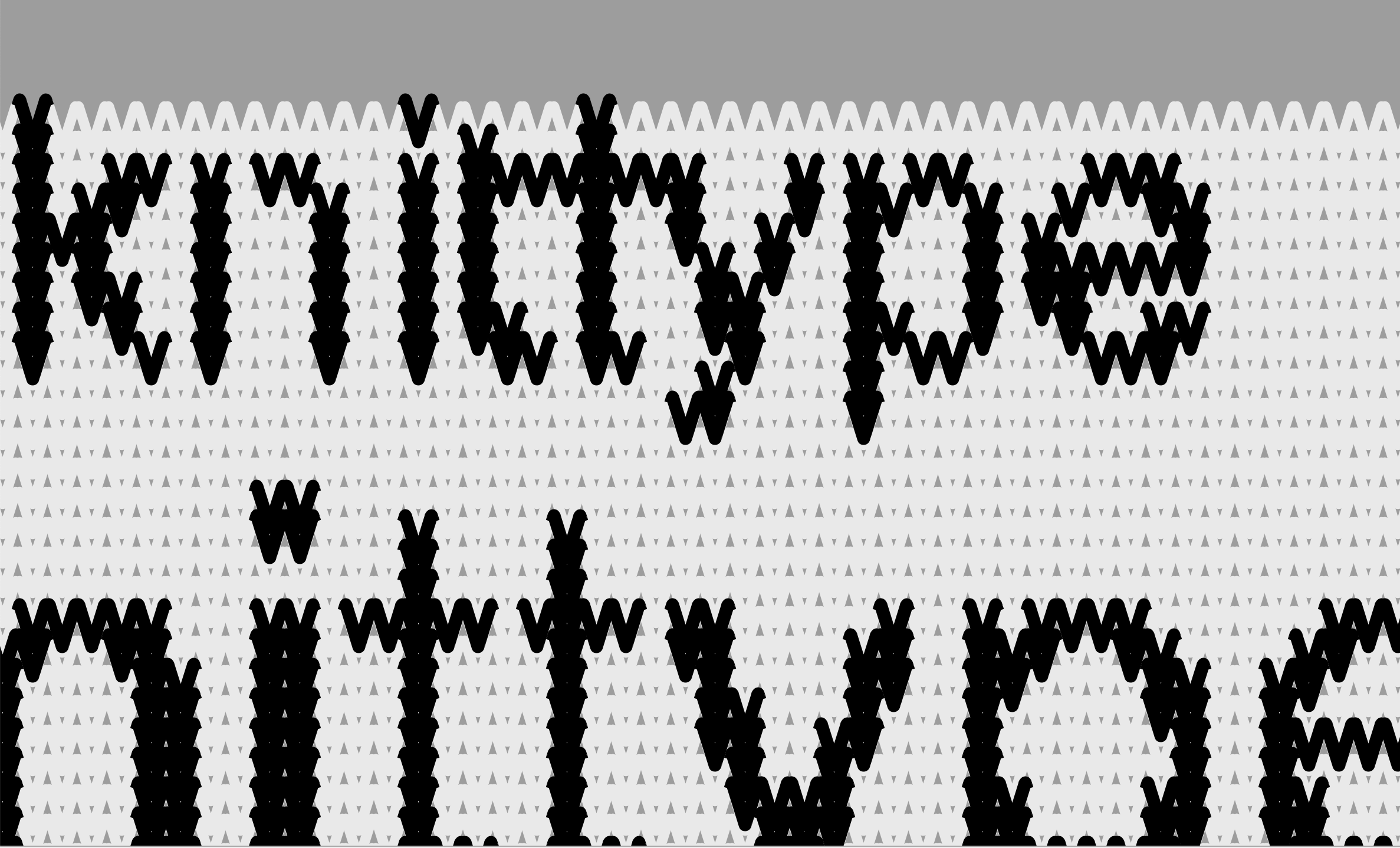
    here it is:

    Copy link
  4. oh, and a humble challenge for masters:

    how do we engineer back of —if we call this a— digital knitting.
    all the floats, loose knots, distortions etc.?
    closing the shapes, connecting the letters. but how?
    back side of this has to be a mess that is all i know.

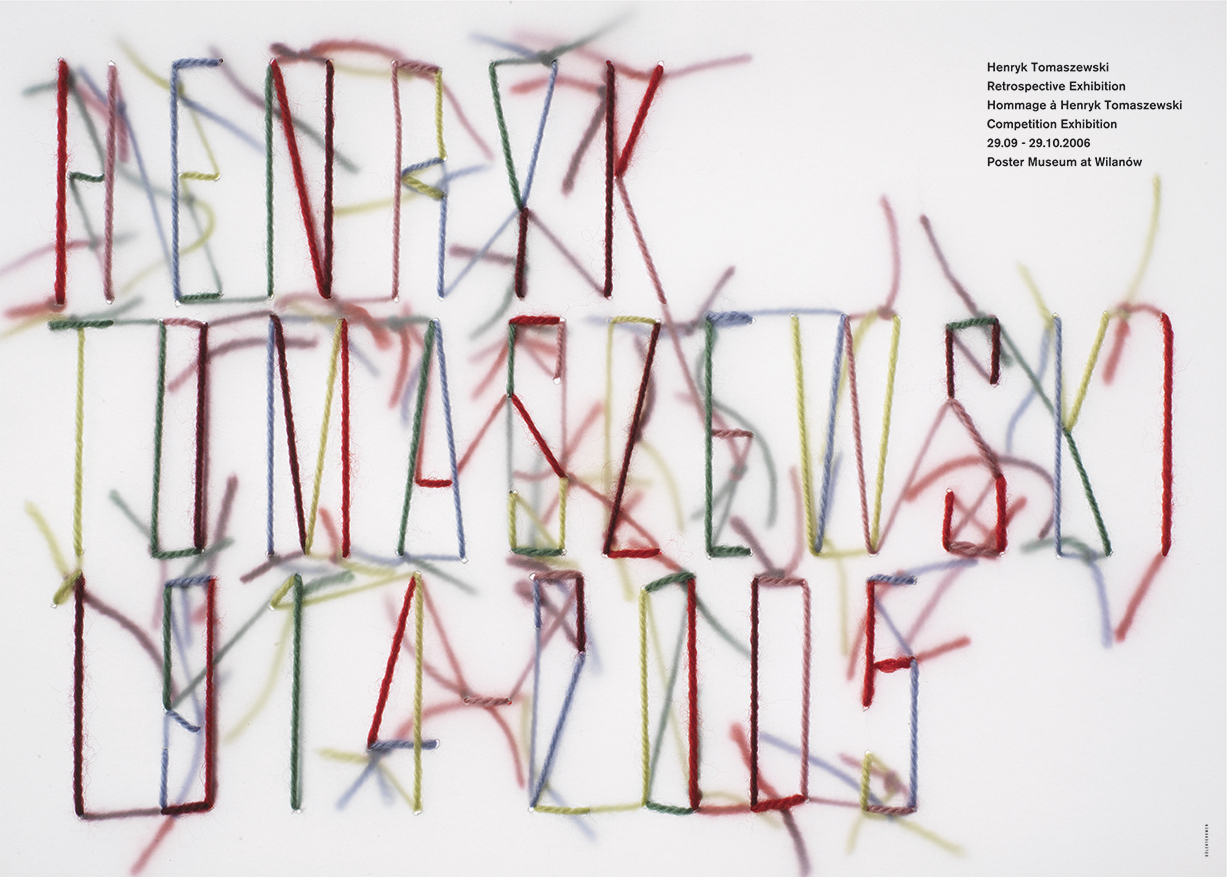
    a reference:

    Copy link
  5. Diov, Tolifox, LastVector,

    My apologies for not jumping on this right away. I have been having technical difficulties with my email app and didn't see this until yesterday.

    But it all worked out for the best, thanks to Tolifox and LastVector. Seeing the Nodebox community rise to the occasion and help each other out warms the cockles of my heart. And props to Diov for coming up with a solution that looks surprisingly good.

    As for your master's challenge: the digital simulation of yarn and textiles is a subject which interests me. Digital simulation using 3D tools like Blender, or bespoke tools, can produce astonishing results. For example:

    https://www.shimaseiki.com/product/design/downloads/fabsim_for3d_form/

    But what could be done in only 2 dimensions, without a physics library, lighting, shaders, etc? I have seen some work in this area, but it's challenging. Here are two somewhat technical papers on the simulation of yarn:

    https://www.researchgate.net/publication/258195797_Computer_Simulation_of_Woven_Fabric_Appearances_Based_on_Digital_Video_Camera_Recordings_of_Moving_Yarns

    https://www.degruyter.com/document/doi/10.1515/aut-2018-0037/html?srsltid=AfmBOoqyDYw89Yk3qXS05rl_1XfLvngaFrVnhLJrhrA4TAN9zwbsZarF

    I think you might get close to this with just some random noise and a set of many short line segments stacked perpendicularly.

    You could use my text_svg node to create simple letters made of line segments and replace each segment with a simulated strand of yarn. Getting the colors right to simulate just a hint of 3D thickness and lighting would require experimentation. If you get that far, connecting letters formed out of yarn should be fairly easy.

    The higher level goal here is how to make vector-based computational art look haphazard and organic. Here is an interesting article on that:

    https://www.generativehut.com/post/how-to-make-generative-art-feel-natural

    I think this is indeed a master level challenge, but with enough persistence I am certain you could create truly interesting results in Nodebox. The goal is not to make something that looks like a photograph of actual fabric, but rather to create an evocative piece of digital art that suggests natural fibers.

    Discuss!
    Copy link

Know something that helps?

Sign in with your email address to reply. No password needed.

Sign in to reply