Hello Colt,
What an interesting challenge!
First, I think it would be wise to take a step back and get a clear idea of what you are trying to accomplish aesthetically. Procedural tools like Nodebox make it easy to create perfect shapes and straight lines. So, on one end of the spectrum, you could embrace that and create clean, minimalist shapes that echo the original designs with a less organic, more geometric vibe.
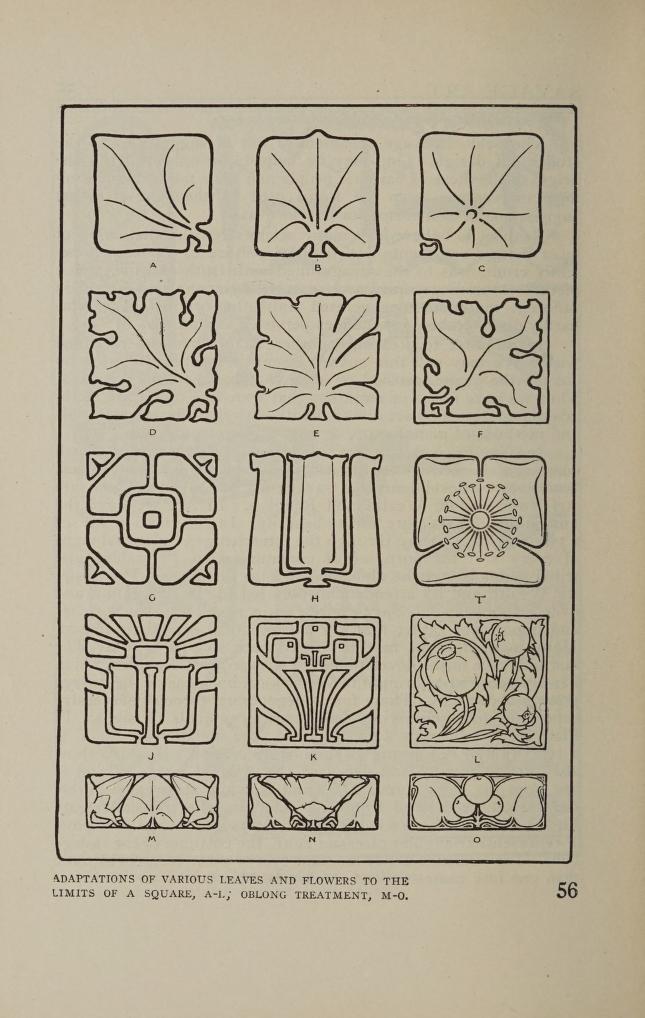
The other end of that spectrum would be to create quirky, imperfect designs that seem hand-drawn. The closer you get to truly human-drawn shapes, with microscopic tremors and completely unique variations at every turn, the harder it is to do. So this is a tempting challenge, but is not for the faint of heart. In theory you could almost exactly recreate your leafy shapes, but probably not in a very parameterized way. That is, each one would be a unique piece; parameters could make shallow variations, like the jump from D to E to F, but probably not deep variations. To make a deeper jump from, say, design D to design L, you would probably have to start over from scratch.
What you may want is somewhere in between. Quirky enough to seem organic, but not so quirky that you can't use parameters to drive meaningful variations. There's no one correct answer here; it depends on what you want to do.
In order to have the kind of parameters you listed, you would need to devise a SYSTEM. That is, you would need to devise an algorithm that would start from basic concepts and iteratively evolve complexity. This is quite challenging.
One highly mathematical approach, used to create natural looking trees, leaves, and ferns, is the Lindenmayer system: https://en.wikipedia.org/wiki/L-system
I'm guessing that, with a background as an illustrator and not a coder, this is probably not something you want to wade into. Which is just as well - since, technically, it requires recursion and state, neither of which Nodebox can fully do. I mention it only to deepen your understanding of how challenging it is to turn math into, say, realistic tomato plants filling a space.
Which is not to say this can't be done. Here, for example, is a recursive tree animation I did years ago: https://forum.nodebox.net/t/18494855/recursive-tree-animation
STILL not what you are asking for, I realize.
To make a system from an illustrator point of view, you would need to think about what all the different shapes in your example have in common. One thing is that each one is almost square shape; that is, each has a complex shape the almost perfectly fills a square.
On systematic way of generating such a shape would be to start with a more organic shape, like a leaf, and fatten it out till it presses against the confines of a square box. But to do this properly you would have to do much more than use the fit node, which would just stretch the leaf horizontally and vertically. You would have to seek out any remaining negative space and try to fill it by altering the the trajectory of each component curve in the path in a proportional way. This is possible but would be hard to do in a generic way.
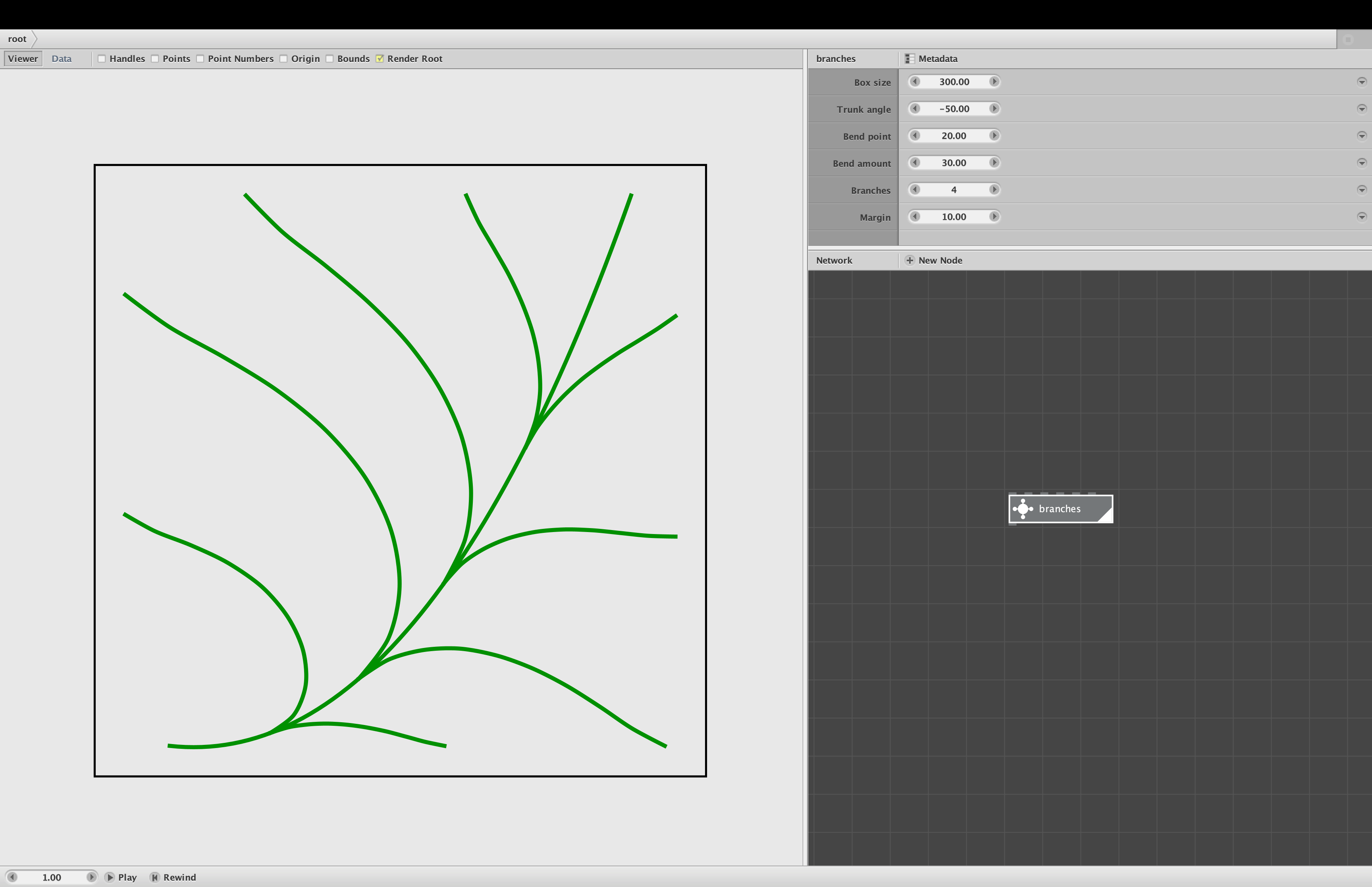
Another thing designs D - F have in common is a branching tree structure, hinted at by the lines. Each branch in the line manifests as a leaf-like structure. Using this insight you could first develop some parameters to generate different branching structures, and then develop a way of turning each "branch" into a square-filling leaf.
In fact, that might be a good first step. Trying making a node that simply generates the faint wiggly lines inside designs D - F. You could have an angle for the main shaft, the number of branches on each side, the wiggliness of each branch, etc. The first parameter should be the size of the square containing these line trees; that will constrain everything that follows.
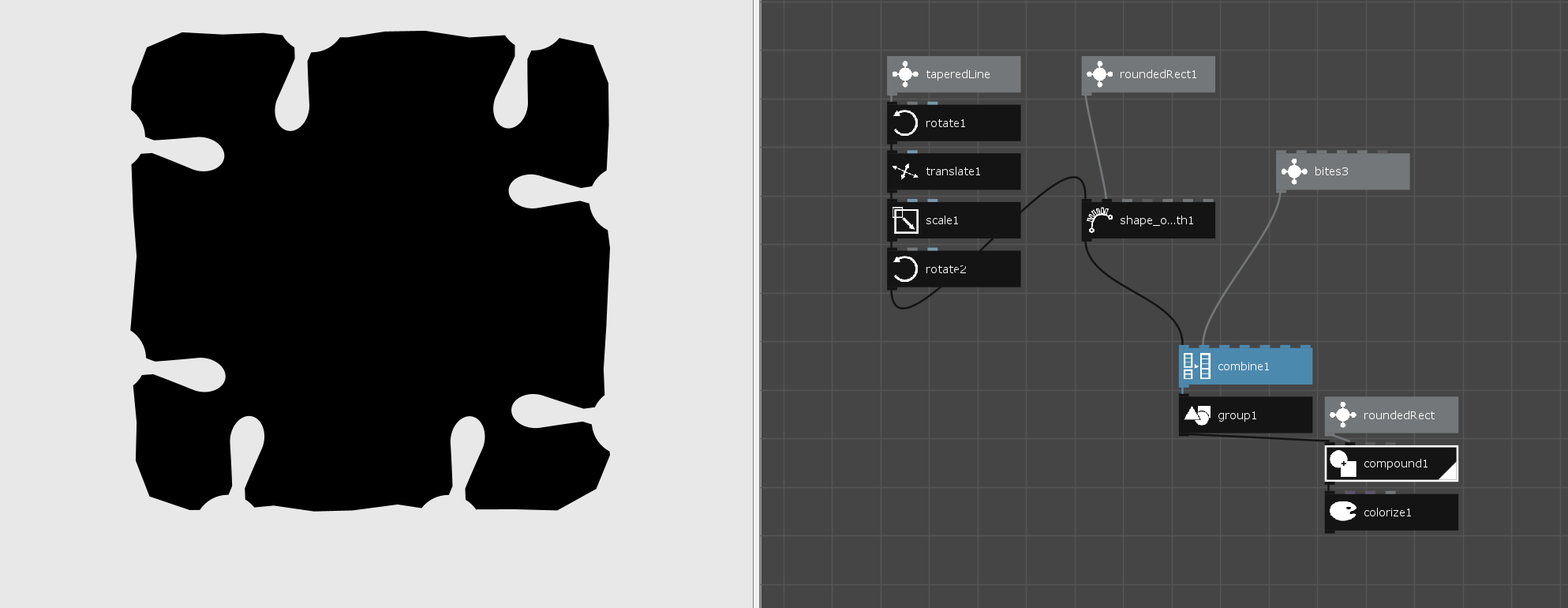
Once you have the basic branching structure defined, you can then make a proto leaf by constructing a kind of trapezoid filling the space around each branch to the edges of the square. You could then start nibbling away at each trapezoid, taking bites the way you did with your initial appoach.
Actually, the path you started down on is not bad: using the compound node to build up shapes and the shape_on_path node to make the beginnings of interesting edges.
You asked about the "loops between segments". I'm not sure exactly what you mean by this. Do you mean the curvy indentations that run along the edge of the shape, forming the "bites"? If so, this is also rather tricky. You could have another parameter that describe how "tight" these bites are. In design E the leaves are tightly pressed together and as a result the bites are relatively shallow. In D and F there is more room between leaves for deeper bites that seem to close together at first and then open uo a little as they penetrate deeper into the plant.
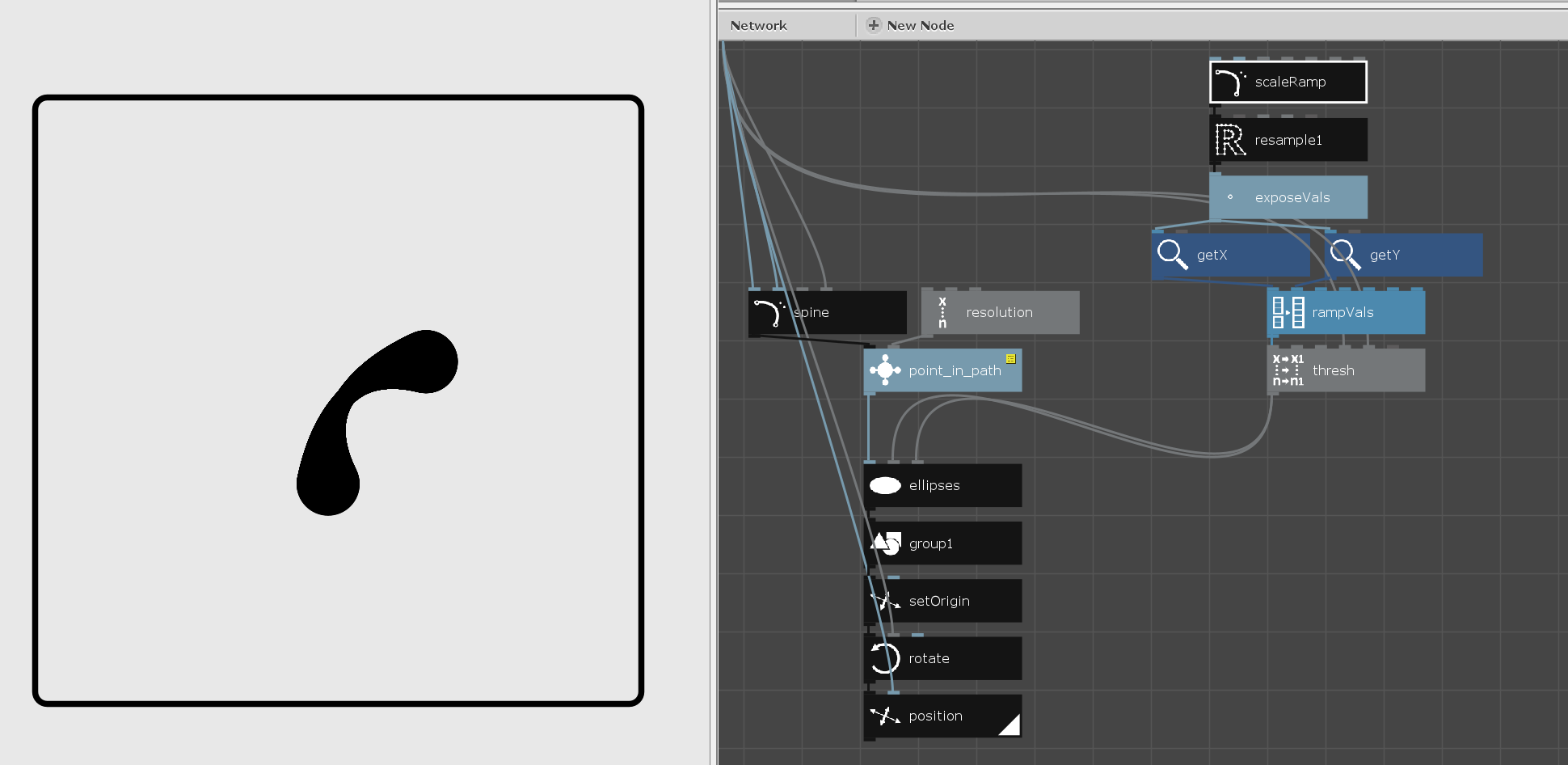
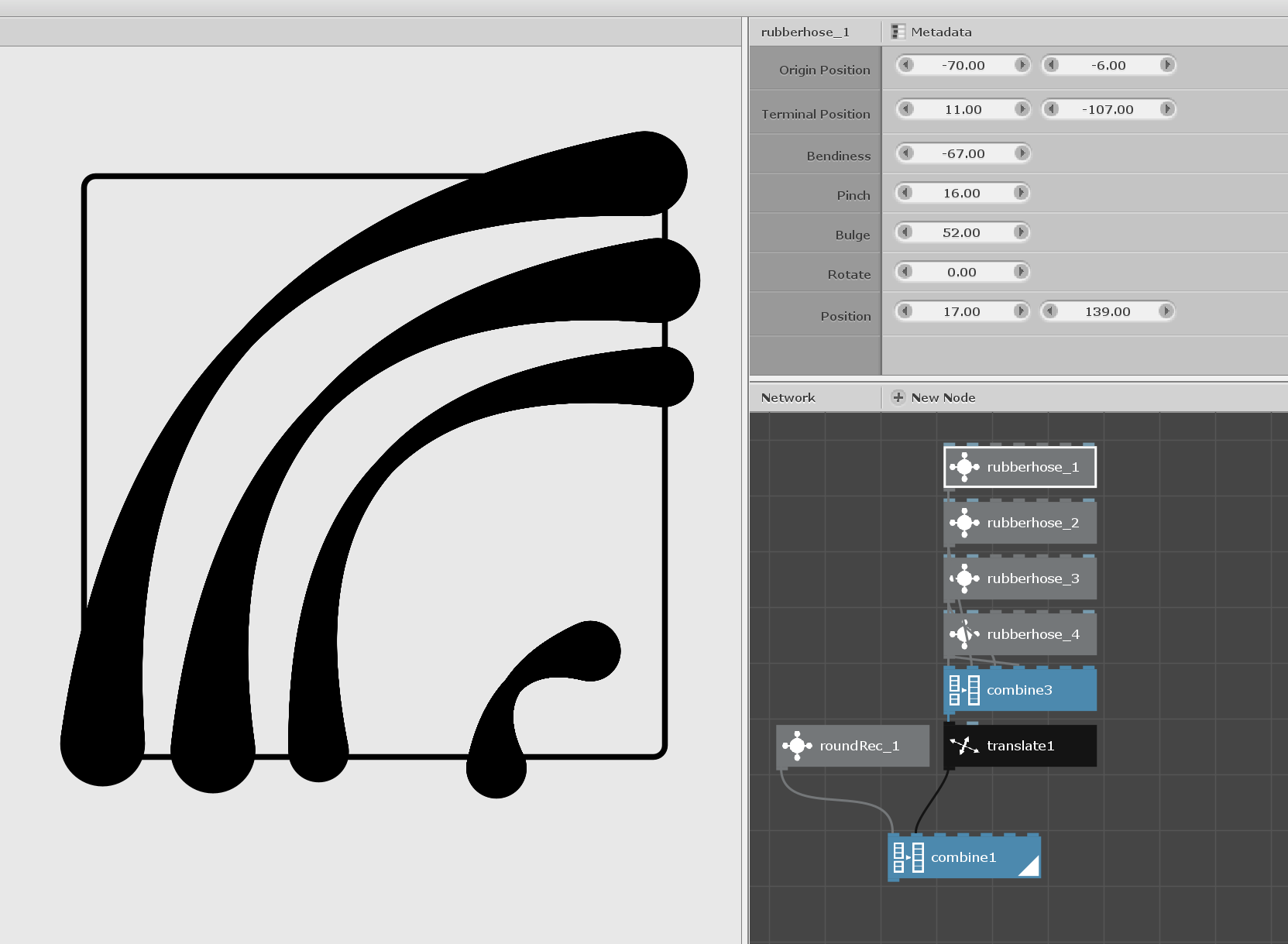
This gets us back to where on that spectrum you want to fall. It might be easy to start with more geometrical designs at first, where each leaf is a trapezoid and the bites are simple droplet shapes that are just subtracted around the edges at regular intervals. Then you could start to add random noise to these shapes (by resampling curves to add more points, use a wiggle node to jostle them a bit, then reconnect them), and gradually move down the spectrum to more quirky, organic designs.
Is this making ANY sense?
As sometimes happens with newbies, you have innocently chosen a fairly formidable challenge here. I often do the same thing when learning a new tool. I think this is actually a good thing - if you have the gumption to stick with it: as an artist your "reach should exceed your grasp". Trying to do impossible things is a great way to learn how to make amazing things.
That, I'm afraid, is my initial stream-of-consciousness reaction. If I haven't completely scared you away, take another swag at it and then, when you get stuck, reply with a zipped copy of your NDBX file and a more precise question, like "how can I make droplet shapes that curve a little to left or right?"
I hope to hear from you again! Keep on playing.
John